Showing posts with label Port Lands and South of Eastern Transportation and Servicing Master Plan. Show all posts

Saturday, August 22, 2015

Better Placed 'Bike Rooms' needed in StudioCentre proposal on Eastern

 - to reduce the rate of increase in neighbourhood motor vehicle volumes 

Ward 30 Bikes' "Eastern Avenue Working Group" is making steady progress on our submission to City Planning about the proposed StudioCentre development on the south side of Eastern Ave between Pape and Larchmount.

From our still-in-draft report, this is a snippet about the Bike Rooms indicated on the drawings near loading docks in 5 buildings:

Bike (parking) Rooms in drawings submitted by StudioCentre are located right next to loading docks. This is the worst place to put them.

Best Practice says they should be view-able from the street like an apartments' front entrance door --- and especially not in a narrow service alley shared with loading docks and a parking garage ramp connected to the street grid via a rear roadway intended mainly for solid waste and delivery trucks.  

As an example of this (and other*) best practice - translated into a retail/office box development context, I sketched a better placed StudioCentre Bike Room on their most recently submitted ground elevation drawings (June 2015).

Full Size: https://blogger.googleusercontent.com/img/b/R29vZ2xl/AVvXsEhvQm1REErU5SOAiSiO89Af1UKGpf147wp0zZ5reiQwDcUPwVaGsG0ApGQf_GMUGnQfNqN3kTfWPAGV-DeCbcEzi-b8ZIHNr_0pEHX4tx9KfyXRfsHSmV3H5NvupezVpwtzl6RcuI33vImT/s1600/Bike+Room+Placement+-+W30B+mark-up+on+developer+changes+presentation+June+2015+public+meeting.jpg


As an example, I moved the Bike Room in Building 03 (southwest corner of Eastern and new lower Caroline) such that it now it has:
  • Two sets of double wide doors right beside the main entrance to the buildings' Foyer (perhaps grocery store style sensor-opening sliding doors?);
  • Two doorways to the Foyer, one that leads directly to the elevator banks, and one that leads to the stairs (totally integrated);
  • Propose a glass street-front wall, and a glass divider wall between the Bike Room and the Foyer (this keeps 'eyes' on the Bike Room and advertises the developer's sustainable transportation amenity - which helps to create buy-in by tenants and employees);
  • Propose a washroom in each Bike Room - which should include a shower and lockers (might consider a cost effective, unisex facility: common counter and sinks; locking, single toilet rooms; locking shower room; a wall of half-high lockers).


* (and other best practice about bike parking) - separate motor vehicle spaces and bike spaces wherever possible; locate bike parking as close to the main entrance as possible; create a safe, accessible, well lit, calm egress to the amenity; create a warm, bright, visible, welcoming bike parking space - via:

City of Toronto May 2008 | "Guidelines for the Design and Management of Bicycle Parking Facilities" - ideas sprinkled through-out the report, specifically see Part 2.4.4 - Indoor Bicycle Parking (Bike Room) - p. 10 | http://www1.toronto.ca/city_of_toronto/city_planning/transportation_planning/files/pdf/bicycle_parking_guidelines_final_may08.pdf


References:

Image source: 629 Eastern Developer Changes (presentation at a June 25, 2015 public meeting at Revivals' newly renovated digital arts studio space off lower Winnifred) | http://www.studiocentre.com/images/Concept%20Plans/1120-Eastern_Av-Concept_Plan-23062015.pdf


mh

Monday, July 27, 2015

Complete Intersections in the context of the StudioCentre proposed development at 629 Eastern

by Michael Holloway
Lead - W30B Eastern Avenue working group


I created this image that attempts a close-to-scale drawing corrected to 180 degrees of the StudioCentre proposed Eastern-Caroline intersection.  The new street south is the same width as Eastern Avenue.


Eastern-Caroline Complete Intersection template.jpg


Copy it and paste it into a mark-up program (like MS Paint) and add your Complete Intersection treatment ideas - and post at the Google Doc we have up for discussion and writing of a report concerning the StudioCentre transportation context.

Google Doc - StudioCentre: Active Transportation Context | https://docs.google.com/document/d/1PvD4PFR1Cx-S0S_4oapq12YwpDE4QvEArOYuEsm1dPg/edit?usp=sharing

EMAIL Ward30Bikes and request editing permission.


The latest proposal includes bike lanes on new lower Caroline as a two-way roadway; existing Caroline remains one-way southbound with a Contraflow Bicycle Lane northbound. At the public meeting in June 2015, in a presentation by the BA Group Transportation specialist, several treatments were proposed for the north side of the intersection intended to prevent southbound Caroline motor vehicle traffic from proceeding south through the intersection (bikes excepted). The intersection is to be a signaled intersection with left turn lanes on westbound Eastern and on northbound Caroline.

Treatments of nearby intersections (Pape, Winnifred, Larchmount, Berkshire, Rushbrooke) to create connections north-south; and to better allow exits and entrances to the Eastern Avenue roadway are also a part of this process (thought we should start at the key, central intersection of the development proposal).


Michael Holloway
July 27, 2015

Saturday, July 4, 2015

Eastern Avenue Don River to Queen-Kingston - Proposed Developments Context

By Michael Holloway
Ward 30 Bikes member


In order to frame the issue more clearly, I made a Eastern Avenue Context Map.

(Full Size: https://blogger.googleusercontent.com/img/b/R29vZ2xl/AVvXsEgbsjljpX0MnwjORGjf89JDSdjnA43WcvOyqRyRo2lAMJDCx1RQmgMLEQzHcs6uR4zVko6b4NFpQj5emPkrgcTIEjWNqm803P0HaUSs0UYnWipOY6QQiCys-tZ_t_2Xui7855u3gDn5LcHa/s1600/Eastern+Avenue+Don+River+to+Queen-Kingston+Rd+-+Proposed+Developments+Context.jpg)

Together these development proposals along (so far) 3/4's of the length of Eastern Ave offer a huge opportunity for us to create a Spine Complete Street and at the same time remediate a major barrier to access to the waterfront along the bottom of our City, and our neighbourhood.

When considering the potential remember, when we talk about a roadway we must consider how it acts both as a connector and as a barrier. Right now Eastern acts as a barrier to east-west cycle traffic because it is not connected west and east, and it also is designed such that getting onto it and off of it, is extremely hazardous. Eastern acts a barrier north-south because is is a 'built-for-speed', 'move-cars-fast' designed street.

Induced traffic via the FirstGulf's Project21 and StudioCentre's developments; plus much higher residential density at the 3 now-in-process condo developments on Eastern (and several nearby on Queen St) means if left as is, Eastern will become a greater barrier, a greater hazard, than it is now.

Not to mention the fine-filtering that increased volumes will induce on the local neighbourhood streets that run off of it (also a barrier for cyclist traffic).

The TTC Russell Yards bottle-neck at Connaught to Minto is a problem and an opportunity. It could be a dangerous pinch point, or it could be the Nut of a beginning of a process of calming Eastern east of Leslie; and the beginning of a vision to create Bike Lanes east of Leslie.

Woodfield Rd is an excellent connector from the top of East York at the Cosburn Bike Lanes, and travels almost straight down to the LDRT on quiet residential streets. As such Woodfield is an opportunity to calm Eastern just west of the high-speed chicane there leading to the new pinch point at Connaught that the TTC is constructing right now.

Michael Holloway
July 4, 2015


mh

Wednesday, July 1, 2015

Cyclist / Pedestrian Turning Count at Rushbrooke & Eastern

By Michael Holloway
Ward 30 Bikes member

The Image below is the results of a Turning Count I did on Tuesday, June 30 at the corner of Rushbrooke and Eastern between 6pm and 7pm (light spitting rain).


The count demonstrates what can be seen by standing and watching the intersection for 5 minutes: in one hour about 50 pedestrians came out of the neighbourhood (mostly via Rushbrooke) in order to cross into FreshCo Parking Lot.

Also of note is the improvised pedestrian crossing just east of the Garage (this is where a pedestrian was killed in 2010).

While I was there two people (separately) stopped to vocalize their support for a Crosswalk with signals. They were both so passionate about it they gave me their names, addresses and phone numbers! (both live at Jones/Queen).

It's a complex intersection - any questions about how to read the count, please ask.


mh

Wednesday, June 24, 2015

8 Concerns around the StudioCentres' proposed development at 629 Eastern Avenue.


Community Meeting #2 is TONIGHT!
Wednesday, June 24, 2015
7:00 PM to 9:00 PM - 629 Eastern Avenue

Some Concerns:
1) 'Back Lot' is isolated from the community - will be difficult to police - not a public space - but rather a security guard protected private space; I think the space needs to be connected to the neighbourhood to the north, create an inviting public space (1 idea I heard at the winter meeting - move the 'Back Lot' to the north perimeter of the site?);

2) Small amount of Park space is being added to the community at Caroline (on the corner of the central transportation nexus of the proposed site) - this is badly placed and represents not nearly enough public benefit;

3) Multi-use Path on new Lower Larchmount is unconnected to the street grid north - including Bruce Junior Public School which will be disconnected from a safe north-south signaled intersection (signals at the bottom of Larchmount to be moved to Caroline, 1 block west);

4) Parking Numbers indicate the development will Induce traffic to the area from far away - this is the wrong sort of development for dense urban core neighbourhood;

5a) While we generally support a fine grained approach to the street grid (short walkable blocks) the Induced Traffic nature of the proposed development means the eastbound Eastern Avenue Bike Lane will be interrupted by 2 new streets south off Eastern - What sort of treatments are proposed to keep Bike Lane users safe at these intersections, create walkable connections north-south? - What kind of traffic numbers are expected at those intersections?;

5b) The LDRT on the Lineal Park on the north side of the Lake Shore Boulevard will have to cross 3 new intersections and one existing that will now be open 24/7 - What kind of treatments are suggested to make those intersections safe for Trail users? - What kind of traffic numbers are expected at those intersections?;

6) Large Retail square area, and extensive parking spot numbers indicate that this is not a 'Good Jobs' employment development (except for the film jobs at Revival 629 Studios - which is existing, refurbished).

7) Because of security concerns, the Film Studio section of the development will be separate from the rest of the development; thus the eastern portion of the proposal is entirely a Low Wage service sector jobs oriented development - Are good ideas like a Film Tech School still on the table? Moving forward? Does the so called, 'Flex Space' in the proposal support possible Film Tech schools?

City of Toronto | Development Applications | 629 Eastern | http://app.toronto.ca/DevelopmentApplications/associatedApplicationsList.do?action=init&folderRsn=3384525&isCofASearch=false
(click on Supporting Documentation to see badly labelled list of Applicant documents - which upon download aren't labelled in English, but rather by file number - so that you have to label them one by one as you download them :/ )

StudioCentre | http://www.studiocentre.com/
StudioCentre - Downloads | http://www.studiocentre.com/downloads.html


mh

Monday, June 22, 2015

Eastern Avenue Pedestrian Crossing and Intersection Calming at Rushbrooke Avenue

By Michael Holloway
Ward 30 Bikes
Monday, June 22, 2015

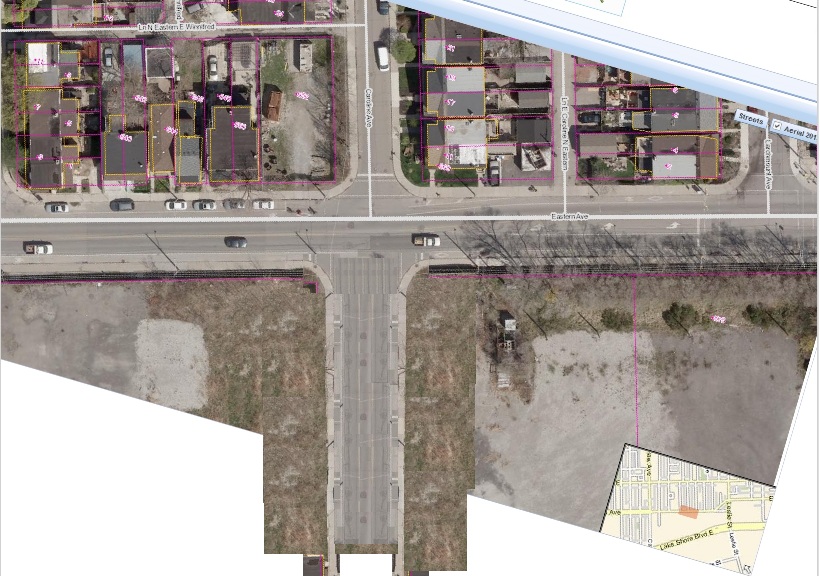
The image is a proposal to add a pedestrian crossing across Eastern Avenue at the bottom of Rushbrooke Avenue. What do you think?

Image mark-up from a screen capture of a detail of the intersection via Toronto Maps v2 (http://map.toronto.ca/maps/map.jsp?app=TorontoMaps_v2&a=2%20Rushbrooke%20Ave)

Eastern Avenue is a designed-for-speed Avenue with Bike Lanes on both sides from Logan to Leslie which has a couple of dangerous chicanes (at Rushbrooke to Leslie; and at Woodfield Rd to Coxwell).

On W30B's Jane's Walk this spring* (which Ward 30 Councillor Paula Fletcher attended) concerning the Ryerson Study we commissioned** - which visioned connecting the Jones Ave Bike Lanes to the Lake via Rushbrooke, Mosely and Leslie - it was not deemed possible to create the route that the Ryerson Students detailed due to a couple of issues.

But one element of the vision which did appear to have legs was a safe crossing for pedestrians (and cyclists) at the bottom of Rushbrooke. I've detailed through the years, many examples of people using Rushbrooke to walk south to the Big Box stores to do their shopping - and finding it quite difficult to cross Eastern Avenue there because of the fast design of the roadway; plus the chicane in the roadway which makes sight lines for both drivers and pedestrians difficult.

During the Jane's Walk a pedestrian crossing came up at the bottom of Rushbrooke as we watched several pedestrians trying to actually run the gauntlet there. Northbound pedestrians loaded with shopping bags - and if they're also parents - with strollers, can be seen having an even more difficult time crossing the roadway.

The image attached is a proposal for discussion, to add a pedestrian crossing across Eastern Avenue at the bottom of Rushbrooke.

I note that at T&EY Community Council a motion*** is in process to create Island Parking on the east side of Rushbrooke to enable more parking on that street for the residents who live there. The proposal also notes the traffic calming effects of Island Parking.

Also of note is item 3 of the motion:
Community Council Decision
The Toronto and East York Community Council - June 16, 2015:
[...]
3: Requested the Director, Transportation Services, Toronto and East York District to undertake a review once the Leslie Barns and connecting track is operational and the cycling contraflow review has been completed.
(my emphasis)

So an amendment that talks to the Ryerson Student's Proposal for a Contra-flow on Rushbrooke? W30B has no knowledge of this.

After some quick number crunching - if the Island Parking goes in, the Ryerson Students proposal for a contra-flow on Rushbrooke goes out the window - because there is not enough width on Rushbrooke to have permanent west side parking, east side Parking Islands and a contra-flow beside the northbound traffic lane at the proposed 3.3 metre width (even at 3m there is not enough room - under a metre).

The drawing notes the start point of the most southerly of the four 2-car, west side, traffic islands proposed.

To make the westbound Eastern Avenue Bike Lanes safer (and to allow less confident eastbound cyclists a route north), I have added another street calming proposal to the drawing, a big bump-out on the northeast corner of the intersection; this plus widened sidewalks on the south side of Eastern Avenue creates a shorter distance across the roadway for pedestrians - and with this, a signaled pedestrian crossing from the northeast corner of Rushbrooke to the south side of Eastern just west of Mosely - at the westbound start of the Eastern Avenue chicane there.

What do you think?


References:
* Jane's Walk 2015 | Connecting Riverdale to the Lake - A Quick Start Proposal | http://janeswalk.org/canada/toronto/connecting-riverdale-lake-quick-start-proposal/
** Connecting Greater Riverdale to the Lake (pdf 69.25MB) | https://www.dropbox.com/s/md354m5wm9yekag/Connecting%20Greater%20Riverdale%20to%20the%20Lake_Final%20Report.pdf?dl=0
***  TE7.88 Parking Regulations - Rushbrooke Avenue | http://app.toronto.ca/tmmis/viewAgendaItemHistory.do?item=2015.TE7.88

Post at this blog: "W30B Jane's Walk: Connecting Riverdale to the Lake - A Quick Start Proposal" | http://ward30bikes.blogspot.ca/2015/04/w30b-janes-walk-connecting-riverdale-to.html


mh

Sunday, June 21, 2015

Smart Centre's 629 Eastern Development - Stormwater Management Opportunities

By Michael Holloway
Ward 30 Bikes
Sunday, June 21, 2015


This is part of a series of articles exploring the lost rivers of east Toronto, and how their still existing flows and stratification under the built form can be harnessed to more cheaply and more sustainably manage increases in the extent and regularity of extreme weather events due to climate change.

I'm reading the updated Functional Servicing & Stage-1 Stormwater Management Report by StudioCentres about their proposed development at 629 Eatsern Ave -

Community Meeting coming up this week:
June 24th,
7pm, at
629 Eastern
Paula Feltcher e-newsletter | StudioCentre development application at 629 Eastern Ave. | http://us2.campaign-archive1.com/?u=2d62749882e2b95305afbebde&id=529e0d63d9&e=c8cc68d5bd.


It looks to me like Smart Centre (and perhaps also City Staff) aren't aware that there is a river running under the west side of Winnifred Avenue at Eastern Avenue.

From StudioCentre | Downloads | Functional Servicing & Stage-1 Stormwater Management Report (page 9 of 79):

(my emphasis)
3.2 Stormwater Management

Existing Conditions

There is an existing 1050mm diameter storm subtrunk sewer located within a service easement situated on the western property limits of the subject site that flows southerly from Eastern Avenue to Lake Shore Boulevard East and services the western portion of the existing site (i.e: Revival Site). It is our understanding based on discussions with City of Toronto staff that this existing 1050mm diameter storm sewer typically runs at capacity under minor storm events and is approximately one third full during dry weather conditions. Given that the subject lands are approximately 1.0 – 2.0 metres above the level of the lake, it can be inferred that this storm subtrunk sewer naturally receives backflow from the Lake Ontario. In addition to this 1050mm storm sewer, there is an existing 450mm diameter storm sewer that consists of the minor local system on Eastern Avenue that appears to primarily provide drainage for the roadway.

The always 1/3 full storm sewer on the western extent of the Studio Centre property is not I believe, just 1/3 full under dry conditions due to seepage from high lake front water table - it is very likely that it is 1/3 full all the time because the river that flows in a line from Dundas/Boston down to Eastern/Winnifred is flowing through it!


It is likely that the river has been redirected into sewer pipes as it crosses the Queen Street Trunk sewer and then again at Eastern where it then flows back to Pape and down the 1 metre subtrunk line noted above.

Interestingly - the flow from that 1 metre trunk line then travels down to Lake Shore where it connects to an east-west trunk sewer that then turns south under Carlaw and empties into the Turning Basin. You can see this flow any day of the year; it comes out just under the water surface, at the northwest corner of the Turning Basin, about 50 metres south of the corner of Commissioners and Carlaw.


My line here is about bringing the lost rivers of east Toronto back to the surface as part of a sustainable stormwater management template for the entire South of Eastern and Port Lands area - including this article on the StudioCentres development at Pape - but also with regards to the First Gulf development on the old UniLever lands - under which a river once flowed into the historical Ashbridges Bay at approximately between Saulter St and Bouchette just west of McCleary Park.


If I were designing a large parcel of land like SmartCentres' 629 Eastern site, I would start by understanding the existing and historical conditions of the property - rather than seeing it as a nice square of land that is ideally placed in the geography of the real estate market to make gobs of money after it is developed in some manner defined more by a business model than by the neighbourhood which it is in (which is what this plan appears to be).

As a stormwater management system, revealing the lost rivers of east Toronto is not only a sustainable system (in that global temperature change is causing increasing frequency, and more intense extreme weather events), but is is also a stormwater management system that would:
  • immediately mitigate basement flooding on the lake front lowlands between Dundas and Eastern;
  • add value to the existing neighbourhood properties and the South of Eastern Employment lands;
  • beautify the waterfront neighbourhoods; 
  • remediate brownfields over time;
  • add to the health and well being of the residents in a intensifying context; 
  • create a world tourist destination;
  • act as a transition element between the old neighbourhood and the new in the form of valley-like built lineal Parks north-south.

So instead of development characterized by boring intersections at Pape, Winnifred, Caroline and Larchmount - and a built form defined by the existing glass and sheet metal street wall at the bottom of Winnifred ...


.. the possibility exists to start with a Lower Winnifred as a winding, bioswale edged - wet-weather open water lowland (dry-weather wet detention basin) with a winding woonerf style neighbourhood street that acts to define the character of the development.

Later - as consecutive extreme weather events continue to increase the cost of maintaining and expanding the under-the-street trunk sewer system - the City might decide that running volatile rivers inside confined stormwater truck sewers under streets might be a losing proposition going forward (an opportunity lost in the expensive basement flooding mitigation project now underway) - and begin the process of bringing the lost rivers back to the surface by adding a wet bioswale to Winnifred starting at Queen, and then perhaps extending it into south of Eastern across the Studio Centre property as a river-feed, open water canal (and extending that south across the Port Lands to the Lake as those precincts develop).

Added benefit: mixed sanitary sewer and river flowing storm sewers would be separated - thus freeing up capacity at the Ashbridges Bay Treatment plant which has to treat slightly infiltrated stormwater/sanitary sewer water during wet weather (which is accomplished by simply adding chlorine to the massive flow and flushing it into the Lake).

That's all for today - I'm continuing to read Studio Centre's Functional Servicing & Stage-1 Stormwater Management Report.


mh

Tuesday, April 14, 2015

Lost Rivers of East Toronto mark possible Canals on the Port Lands; Connect the City to the Lake


I've done more work on the “Canals on the Port Lands” idea that I represented during the July 23-24, 2014 Shipping Channel Charrette organized by City Planning - and in all the phases of the Port Lands Acceleration Initiative (PLAI) public consultation process.

The idea is to pinpoint the most effective and sustainable starting points and routes of possible bioswale-edged, open-water canals extending from the existing flow basins north of Eastern Avenue, and extending them south down to the lakefront such that they mimic natural water courses (that still exist in stratification under modern fill) as part of a storm-water/water-table management system on a redeveloped Port Lands and nearby environs.

This storm water management system would be associated with Green Streets and could then be developed as transportation corridors (including connection points for swing-aside, floating bike bridges across the great barrier to north-south transit, the Shipping Channel), and many other recreational opportunities - and - would be a landscape feature that would greatly increase the sense of well being and general health of existing and planned communities in the Port Lands and environs.

This new feature will also greatly increase the value of those lands via the features' visual magnificence. As well, bioswale-edged, open-water canals would completely remediate the Port Land's brownfields (toxic, polluted land) over time.

This storm water management system would reflect the natural history of this place; and this is essential in this era of rising global temperatures and the effect that has in increasing the rate of extreme storm events which will cause storm-surge cresting in Toronto's (now mainly buried and redirected into sewers), natural drainage flow-ways.

The Process of Discovering the Buried Rivers of East Toronto

Since the Shipping Channel Charrette I've done walks of an area bordered by the Don River, Hogarth Ave, Woodfield Rd and Lake Shore Boulevard. Focusing on the landscape proximate to Eastern Avenue, I have aimed to understand the coarse of these river under the modern street grid from their mouths on the historical Ashbridge's Bay all the way to their headwaters - often well north of Danforth Avenue.

I've used historical research, landscape observations; historical maps; historical Ashbridge's Bay depth sound maps and historical and modern contour maps.

These creek and river valleys reveal paleontological underground topographic forms created by run off in the last ice age (as well as glacial scraping) now buried under more recent sedimentation and later modern fill, in the South of Eastern area of the Port Lands Acceleration Initiative (PLAI) study area.

The Post-Glacial Drainage System of Toronto

The topography of Toronto is characterized by flutes in the landscape that run from northwest to southeast.

These flutes were formed as the Laurentide Ice Sheet retreated towards the northwest in this region about 13.000 years ago. The run off from this late phase of glaciation in the last ice age created these flutes that are arranged approximately 1 km apart across the southern Ontario region. They are evident on the landscape still - even under the urban built form and street grid layered on top of them. They can be seen on the landscape as a series of rises and valleys we know as the Ravines.

Map of Flutes and Drumlins in West Toronto

(Via Lost Rivers - http://www.lostrivers.ca/content/points/drumlins.html)

These ravines are a fingerprint of the last glacial age, and mark the beginning point of the re-creation of the living biosphere here - and coincidentally, the re-habitation of this place by prehistoric humans. As such, they are key to the historical culture of this place and the future sustainability of development in this place.

The Ancient Creeks and Rivers of the South Riverdale Drainage System

On an historical contour map of East Toronto from 1921, I've drawn in blue lines along routes which the contour lines indicate are valleys in South Riverdale. I've also added labels along the left and bottom edge of this map to indicate the approximate position of the modern street network.

(Via University of Toronto Libraries - Don Valley Historical Mapping Project - Contour map of Toronto district - Lazenby, Paul H.; Toronto Transportation Commission,1921 - Call Number: G3524.T6 C222 19 1921 R - http://maps.library.utoronto.ca/dvhmp/maps.html)
(Disregard the furthest east conjecture - that one's just wrong.  :)

The best modern contour map I could find of East Toronto is from the Natural Resources Canada, GeoGratis (v2.0); Search: "Toronto, York, Ontario (City)", Subject Keywords: "contour, map,". The image below is a cropped version of the pdf contour map of Lake Ontario bottom, which includes a base map of Toronto that has a fairly good modern contour grid on it.

Toronto, Lake Ontario | http://ftp2.cits.rncan.gc.ca/pub/geott/ess_pubs/123/123145/gscgsm_8412G_b_1987_mn01.pdf

To better pinpoint the location where these rivers and creeks drained into historical Ashbridge's Bay, I used this depth sound map from 1912 that shows the depth of the Ashbridge's Bay swamp at various points measured using a sounding weight. These depth measurements allow one to understand the underwater (now under landfill) soil stratification as well as the various flow rates of the rivers and creeks.

Via University of Toronto Libraries - Don Valley Historical Mapping Project - Toronto Harbour Commission, Waterfront Conditions 1912,  E.L. Cousins, Chief Engineer & manager; Toronto Harbour Commissioners, Call Number: G3524.T621 24 1912 - http://maps.library.utoronto.ca/dvhmp/Scans/G_3524_T621_24_1912.jpg)

A recent TRCA contour map shows the regulatory flood plain north of the Port Lands in the South of Eastern area (Spill Zone 2). One can see low points (contours that drive north of the general latitude of the flood plain's northern border) where ravines once likely ran with rivers.

The map shows multiple ravines near Jones, Rushbrook and Curzon indicating possible canal route at Leslie St on the Port Lands; at Geenwood, Highfield, Woodfield and Hiawatha a series of ravines indicate a possible canal in the South of Eastern area south of Jonathan Ashbridges Bay Park, and then south just east of Coxwell Ave down to present day Ashbridge's Bay.

Softer juts north (likely due to high amounts of landfill/landscaping) indicate valleys at Heward, Pape/Winnifred, Caroline/Larchmount - indicating possible canal route along the east side of the Turning Basin on the Port Lands. Contours of the flood plain  indicated by long dives northward at Lewis and Saulter indicate another possible bioswale-edged, open-water canal at near McCleary Park on the Port Lands.

TRCA - Lower Don River Regulatory Flood Plain - Spill Zone 2 Diagram
TRCA - Lower Don River West Remedial Flood Protection Project Environmental Study Report | p. 1 - Figure 1.1 - Regulatory Floodplains along the Lower Don River (http://www.trca.on.ca/dotAsset/25780.pdf)

With the aid of a 1902 Map of East Toronto that indicates the position of valleys and rivers at that time ...

Villiers Sankey Map of Toronto 1902_G_3524_T61_1902 - University of Toronto Libraries - Don Valley Historical Mapping Project  - http://maps.library.utoronto.ca/dvhmp/maps.html)

.. I have transposed the position of the now underground rivers which once flowed into the Ashbridge's Bay lowlands onto a Google Map which includes a modern street grid layer. These four sources layered together provide a very accurate picture of where the lost rivers of East Toronto run under the modern built form, and where they drained into historical Ashbridge's Bay.

South Riverdale Drainage System Google Map

View South Riverdale Drainage System in a larger map

(This is an ongoing project - walking the neighbourhoods to identify the valleys under the street grid is essential to understanding the paths of these rivers under landfilled urban built form - to date (April 2015) I have walked the entire extent of the Caroline/Larchmount River, the Leslie Grove Park River; walked the south of Danforth section of the Greenwood Brickworks River, and south of Gerrard section of the Ashbridge's Creek - thus - at the time of this publishing, lines on the Google Map outside of these walked areas might not be particularly accurate.) 

The light Blue line is the planned extreme crest spillway for a naturalized mouth of the Don River. The north-south avocado-green line represents a PLAI vision - a 'Green Gateway' to the beach on Cheery Street below the lift bridge. The two east-west avocado-green lines represent PLAI's visioned bioswales along those roadways.


To this point (April 2015) I have walked the street grid attempting to identify the coarse of the following rivers and creeks (I've named them, or where historical sources provide, used those names): 
  • Caroline/Larchmount Creek* (headwaters starting in the Millbrook Crescent/Ingram Ave  hollow - and a tributary under Withrow Park; down to Carlaw/Gerrard, under Dundas/Boston Ave, Queen/Pape and into Historical Ashbridge's Bay at Eastern between Caroline and Larchmount - currently, modern landfill that makes up the back lot of Revival 629 Movie Studios shows evidence of the river under ground there continuing south to the Lower Don Recreation Trail  - I believe the Lake Shore Boulevard acts as a dam at that point, which has created wet topography there which is supporting a grove of willow trees);
  • Leslie Grove Park River (Wroxeter/Pape, under Gerrard Square, Marjory Ave, Leslie Grove Park and entering historical Ashbridge's Bay at Eastern/Leslie St - under Loblaws' north parking lot - which is landfill); 
  • the southern reaches of Greenwood Brickworks River (Sammon Ave/Donlands, under The Only Cafe at Danforth, Phin Ave Park, the TTC Greenwood Yards, Greenwood Park, Maple Leaf Forever Park and into ancient Ashbridge's Bay at Eastern Avenue); 
  • and the south reaches of the Ashbridge's River (starts under Greenwood Secondary School, and a tributary under Robertson Parkette - 1549 Danforth, west of Coxwell/Danforth - then under Monarch Park Collegiate Institute, Hiawatha/Gerrard, Dundas near Highfield Rd, under Duke of Connaught Junior/Senior Public School, S.H. Armstrong Community Centre, under that huge willow tree in Ashbridges Estate Park - 1444 Queen Street East; and then under TTC Russel Yards to Eastern where it drained into historical Ashbridge's Bay).
_________

* What I'm calling the Caroline/Larchmount Creek, "Lost Rivers" website is calling the Heward /Holly/Mill Brook Creek.

From Schedule of Planned Walks (accessed April 2015):
Sunday, February 15, 2015, 2 pm – Mid-Winter Walk in Riverdale: Heward /Holly/Mill Brook. From Leslieville to Playter Estates, we’ll tour the first major lost creek east of the Don. Long buried, this stream with several names once scored the landscape, creating the contours of Withrow Park. And it inflected our narratives of the East End, from brick-works and needle trades to coffee shops and dog parks. John Wilson and Joanne Doucette (author of Pigs, Flowers and Bricks: A History of Leslieville to 1920) invite you to share neighbourhood scenes and stories. Meet at Queen and Pape; end at Carrot Common near Chester subway station.

See my Google Map, "South Riverdale Drainage System" to check out the routes of these and more East Toronto Lost Rivers (also embedded above).

A Dialectic of Benefits

These water coarse would be positioned starting where historical rivers and creeks once flowed across the landscape - as these natural geological places mark low points in still existing drainage basins - now under unstratified fill.

This specific bioswale-canal placement will help drain storm water in the most efficient manner possible; an important consideration when understood within the context of higher than normal lake levels and a higher rate of extraordinary flood events due to apparently, unabated human caused, carbon loading of the atmosphere which is leading to warmer global atmospheric temperatures leading to glacial and polar ice cap melting.

Alongside these bioswale edged canals might be constructed "Green Streets" - which drain their storm water into the proximate 'new-form' storm water drainage infrastructure. These green streets are key in the lowland Port Lands area as sewer systems will need to be above the lake level - plus, this kind of storm water management is much cheaper than conventional storm water management systems using buried pipes. As well, this bioswale canal storm water management system would be much cheaper to maintain than conventional systems.

New Green Streets roadways would parallel existing (currently underground) water courses (which define the most effective locations for a bioswale coarse) which are in turn, defined by low points in the natural drainage basins - which are identified by the known coarse of historical creeks and rivers.


Images of a Green Street Construction technique - from Land8 | http://land8.com/group/greenstreets

In some cases this approach might present opportunities to extend these bioswale edged Green Streets north of Eastern into the existing neighbourhoods - which would dramatically increase the value of these properties - both in that drainage would be better and thus ground water levels would be consistently lower (thus less or no basement flooding) and the effect of the resulting green spaces would increase the value of the land in a spiritual sense - homes adjacent to, or with a view of these bioswale canals, would accrue in value in the market place.

The new-form water management infrastructure would create a lower water table and reduce (perhaps eliminate) instances of wet basements and flooding in the existing urban built form there; thus increasing land values and development opportunities just north of Eastern Avenue - land that has had historically depressed value compared to nearby land on slightly higher elevation.

This base infrastructure on the Port Lands proper would at once create visual benefits, transportation, recreational opportunities, livable neighbourhoods, health and well being, plus brown-field decontamination and higher land values immediately as well as increasingly over the long term.

I believe that in order for this concept to be effectively deployed it has to be a prominent feature in the Port Lands and South of Eastern Transportation and Servicing Master Plan.

I have tried to include these ideas - only in their infancy at the time - over the two days of the July 2014 PLAI Charrette; but also in my web submission after attending the first public consultation in the fall 2013 - the "Port Lands and South of Eastern Public Meeting #1" (November 28, 2013, at Riverdale Collegiate).


Mapping these ideas:

More on these natural water coarse as part of a transportation visioning for short, medium and long term connections from the neighbourhoods to the waterfront - all plotted on a Google map with the map's Place Mark notations listed in the blog:

Ward 30 Bikes - Thursday, July 24, 2014 | 'Idea Mapping' the Shipping Channel Charrette | http://ward30bikes.blogspot.ca/2014/07/the-shipping-channel-charrette-july-23.html


Bioswale Links:

OMSI Parking Lot Swales - The City of Portland, Oregon [PDF] | https://www.portlandoregon.gov/bes/article/78489

Sustainable Horticulture | Green Streets/Bioswales/Rain Gardens | http://www.sustainablehort.com/?p=177

United States EPA | What is Green Infrastructure? / Bioswales | http://water.epa.gov/infrastructure/greeninfrastructure/gi_what.cfm#bioswales


PLAI Links:


Port Lands Acceleration Initiative: Home | http://www.portlandsconsultation.ca/

Port Lands Planning Framework, July 23-24 2014 Charrette Summary | http://portlandsconsultation.ca/sites/all/themes/portlands/files/Port%20Lands%20Charrette%20REPORT.pdf


Michael Holloway
Resident, Leslieville, Toronto
Member, Ward 30 Bikes,
Cycle Toronto
PLAI SAC


mh

Wednesday, March 11, 2015

A Better Cycling Route to the Lake

Originally posted on riverdaler.ca. Re-posted with permission.

The City From Tommy Thompson Park (The Leslie Spit)

It’s easy to forget that Riverdale is close to the lake. Riverside and Leslieville are even closer, yet obstacles like Lakeshore Boulevard and the Port Lands can make our neighbourhoods feel disconnected from the wonderful gems like Cherry Beach and Tommy Thompson Park.

Connecting Greater Riverdale to the Lake Presentation at the South Riverdale Community Health Centre. Feb. 9, 2015

A group of students from Ryerson's School of Urban and Regional Planning have set out to change that. They have put together a detailed report (pdf) called Connecting Greater Riverdale to the Lake. The report takes a detailed look at the current transportation infrastructure in Ward 30 and suggests five potential "quick start" projects that could provide safe cycling routes that connect the Danforth in the north to lake in the south. The authors of the report presented their findings at a community meeting on February 9th at the South Riverdale Community Health Centre.

 
The proposed routes. Source: Connecting Greater Riverdale to the Lake

A quick start project is meant to be affordable and achievable in a relatively short time frame. After evaluating the five potential routes the group concluded that the Jones-Rushbrook-Leslie route (the green route on the map above) is the best candidate for a quick start project for a variety of reasons including how centrally located Jones is and the fact that Jones already has bike lanes. The authors of the report estimate that the cycling route along with a corresponding wayfinding strategy could be implemented for under $100,000.
Route evaluation matrix Source: Connecting Greater Riverdale to the Lake

The route isn’t without it’s challenges: including a short jog on Queen from Jones to Rushbrooke where there isn’t room for a bike lane and a tricky intersection where Rushbrooke, Eastern Avenue and Mosley Street meet. The group came up with clever solutions to overcome these obstacles like a cyclist refuge island (similar to the one where the Lower Don Trail intersects Pottery Road) at the Rushbrooke/Eastern/Mosley intersection.

The Rushbrooke/Eastern/Mosley intersection proposal Source: Connecting Greater Riverdale to the Lake


The community members at the presentation seemed to like all of the proposed routes and wanted them constructed. Some people thought that the difficulties at the south end of the proposed Jones-Rushbrook-Leslie route were a “compromise” and that bike lanes should have been built on Leslie – especially since the street is being reconstructed for the new streetcar tracks to the Leslie Barns. A lot of people at the meeting also seemed to like the Logan and Carlaw route to the lake. Toronto-Danforth MPP Peter Tabuns, and Ravi Joshi from Councillor Paula Fletcher’s office were in attendance at the meeting.

Which of the proposed routes do you think is best? What will it take to get a better cycling route to the lake? Let us know in the comments!


- by Ward 30 Bikes' member, Mark Hutchinson.

Originally published at the Riverdaler - 2015-02-14 | A Better Cycling Route to the Lake | http://www.riverdaler.ca/2015/better-cycling-to-the-lake/


writer m-hutchinson/editor m-holloway

Monday, March 9, 2015

First Gulf's 21 Don Roadway/UniLever lands development Public Consultation Meeting #1


First Gulf's "Project 21" Community Consultation

First Gulf is looking to develop the old Lever Brother's site at the foot of Don Roadway and Lakeshore Boulevard. It's an ambitious plan, and made more so by the fact that the city has asked them to develop a Master Plan for the entire block of land east of the Don River, bounded by Eastern Avenue, Booth Street and Lakeshore Boulevard. The site is 60 acres and includes land owned by the City, Enbridge Gas, Cinespace Film Studios.

First Gulf have stated they're looking to build 12 million square feet of office space (think a 4-tower TD Centre spread in lower-height buildings over the 60 acres) but their plan is dependent on 3 pre-conditions:

1. The completion of the naturalization of the Don River in order to permit construction on what is now a flood plain.

2. Transportation access, including A Go-Train or Smart Track stop, TTC transit (via a Downtown Relief Line station or a Broadview streetcar extension).

3. A diversion of the Gardiner (they have gone from supporting the elimination of the eastern Gardiner to a proposal to move the Gardiner - Don Valley connection).

The good news is that First Gulf is taking a proactive approach in reaching out to the community. First, Ward 30 Bikes was invited to a site walk on January 17 with Derek Goring, the Vice President of Development and the person in charge of this project. He gave us an overview of First Gulf's vision for the lands along with a candid explanation of the challenges they face. Our impressions were that it is a massive site whose development would indeed transform the area. Here are a couple of pictures we took along the way:

Looking North-west from Lakeshore near the Don Roadway (Image Gerry Brown)


Picture this space filled with low-rise office space (Image Gerry Brown)


Looking south-west from along Eastern Avenue - Enbridge lands are in the foreground (Image Gerry Brown)


More pictures can be found in our earlier pos: http://ward30bikes.blogspot.ca/2014/12/21-don-roadway-walk-about-leg-1-railway.html

And this week, First Gulf held a meeting to engage the community and to develop a stakeholder committee. It's early days and this is a plan that will span decades, but it's good to see a developer seeking input at an early stage. There are many questions to be answered over the coming months but First Gulf are looking to finish the Master Plan before the end of the year. If you're interested in what Ward 30 will look like in 20 - 30 years, this is a project that deserves your attention. If you'd like a more in-depth look at the project, here's a link from Urban Toronto

http://urbantoronto.ca/news/2015/03/first-gulf-engages-community-transformative-project-21

One final point - First Gulf don't have an official name for the project yet (Project 21 is a placeholder) so if you've got a suggestion, let them know.


Gerry Brown
Ward 30 Bikes


mh

Wednesday, September 3, 2014

Connecting Greater Riverdale to the Lake


School of Urban and Regional Planning
Ryerson University
Advanced Planning Studio - Fall 2014
"Connecting Greater Riverdale to the Lake"
Terms of Reference

In January of this year Paul Young and myself talked with Ryerson University Professor Don Verbanac about using the problem of the limited number of connections that are available between South Riverdale and the Lake Ontario water front, in the practical planning coarse he teaches every fall at Ryerson's School of Urban and Regional Planning.

He has accepted our challenge and is about to put it to his students in this fall's Advanced Planning Studio course.

Paul Young, a Health Promoter at South Riverdale Community Health Centre (Queen St. East and Carlaw Ave), and myself, Michael Holloway, Captain of Ward 30 Bikes (the Cycle Toronto Ward advocacy group for the area), will act as the Clients.

The students will analyze the problem and produce a do-able plan, and a multi-media presentation of that plan.

Tomorrow is a visit to the Planning Studio at Ryerson to outline our problem and answer any questions the student Planners have about it.

Next week is a ride down Logan Ave and proximate environs to look at existing conditions.

Down the road there will be a stakeholders' meeting in the neighbourhood.


Do you have any ideas you think we should take to the process? Please let us know.

Image of the Terms of Reference .PDF


(click for full size - opens in new tab/window)

(click for full size - opens in new tab/window)

Full Size Image URL: https://blogger.googleusercontent.com/img/b/R29vZ2xl/AVvXsEiyDzYcCBILAuRMeceg8VsNgTc7KHasd2gZcjMFCYyTiqz8x4TQsO2QLKr_usSV64WrjQeSz0YeADCZafyxhWL7LFkeC5fJLqsYv6oV-BxroOo2PPPv9uLwBNcMRouSH_lTX00a6d0TVnoN/s3200/Connecting+Greater+Riverdale+to+the+Lake+-+TERMS+OF+REFERENCE+-+RYERSON+UNIVERSITY+-+SCHOOL+OF+URBAN+AND+REGIONAL+PLANNING+-+Fall+2014.JPG


Live Links to References


1. Toronto Public Health. Road to Health: Improving Walking and Cycling in Toronto
(April 2012). Retrieved August 07, 2014 from:
http://www.toronto.ca/health/hphe/pdf/roadtohealth.pdf

2. City of Toronto. Toronto Cycling Statistics. Retrieved August 21, 2014 from:
http://www1.toronto.ca/wps/portal/contentonly?vgnextoid=caa5970aa08c1410VgnVCM10000071d60f89RCRD

3. University of British Columbia. GEOG350/2010WT1/SouthRiverdaleToronto.
Retrieved August 07, 2014 from:
http://wiki.ubc.ca/Course:GEOG350/2010WT1/SouthRiverdaleToronto


mh

Friday, August 29, 2014

New Cycling route through Revival 629 Studios avoids Carlaw

Egress rules across the Lineal Park were supposed to keep the Revival 629 Studio's LSB gate closed, except 11pm to 7am.

It's been open all the time now for quite a while (weeks? - months?) ...

.. And cyclists have already started using it as a safe route between the Lower Don Recreation Trail and the Eastern Avenue Bike Lanes.

New Cycling route through Revival 629 Studios avoids Carlaw


Northbound, take the west-side-of-the-building path up to Pape. Southbound you may choose to enter at the east gates (just west of Winnifred) and ride across the top to the west-side path

It's great! It avoids the nearby narrow, congested, ugly, dirty, dangerous, pot-holed Carlaw Avenue - excellently. :)

But what does it say about Small Blocks as a way to create livable neighbourhoods all along the South of Eastern study area generally, and the StudioCentre proposed development specifically?

Small Blocks are really important - but so far we haven't been successful at creating Complete Streets through intersections that cross Lake Shore Boulevard; part of that is political part of it is cultural - the other part is mechanical.

How do we create Complete Streets intersections at these new neighbourhood streets that cross a Grand Boulevard like Lake Shore Boulevard?:

I expect the answer is that we cannot have Grand Boulevards - don't need Grand Boulevards - of the type that we have now here in this Lake Shore Boulevard.


mh

Thursday, August 7, 2014

Masters of Industry: South Riverdale to be the new West-of-Spadina High-rise Tower Goldmine

Finance - Industry would line East Waterfront with Highrise Condo Towers from Don River to Woodbine.

By Michael Holloway 

Streetcar Developments - the developer who bought Jilly's - and is voluntarily including low income units in their plan for the remodeling of the property - have also acquired a 4 acre site between Eastern and Queen along the Don Roadway, a project they're calling "Riverside Square".

Streetcar Developments Site Context drawing - Cycling Connections


It's not Mid-rise - it's Highrise - and it's a good indication why the developer did the 'loss-leader' thing about the low income units at the Jillys' proposed development. A little good-will goes a long way (a long way Up - in this case).

Jillys' is the 'Hi how are ya?'

The three, 7, 13 and 24 story towers are the,

'I'm your new neighbour (with the three loud barking dogs).'

But in case, the new neighbour with the loud dogs didn't just buy the house next door - they bought the whole block, and all the blocks in a 1/2km radius!

Welcome to the neighbourhood - I guess...

The good news is this company gets the Complete Streets and Sustainable Transportation part that going up 22 stories necessitates (that Mid-rise on the Avenues necessitates for that matter).

Quoting a recent letter to the Broadview/Queen Community:

"Given the scale and location of Riverside Square we see great opportunity to make much needed bike and pedestrian connections across the Don River to Corktown Common, provide new green space and perhaps most importantly: reintegrate the site into the traditional mixed-use character of the Queen East while providing valuable new services and publicly accessible amenities to the community."

Just so we're all on the same page on this - the elites, the establishment of this country - the banks, the financial institutions and their governments - are out of room on the West of Spadina side of Toronto's downtown - there's no room in South Parkdale - they can't build along the bottom of High Park

And so mark my words - and this development proposal and the First Gulf Leaver site proposal (that visions a Second City Centre anchored by a World Trade Center style array of towers) are the indicators - South Riverdale (and the new Lower South Riverdale, the Port Lands), is the new West-of-Spadina.

The functioning of greed and powerful special interest is visioning miles and miles of lake front highrise towers made of ticky-tacky* - all the way to Woodbine. A wall of private development that will create a another barrier to the water at the Lake front - a barrier to all but those who buy south-facing concrete cubicals (with windows that don't open).

Information link (via Paul Young newsletter) Spring Realty inc. | "Streetcar Plans Largest Development in Riverside History" | http://springrealty.ca/?breaking-news-streetcar-plans-largest-development-in-riverside-history.&p=5340


References:


Streetcar Developments | Riverside Square | http://streetcar.ca/welcome-riverside-square/

* 'tickey-tacky'? --> Pete Seeger - Little Boxes


mh

Thursday, July 24, 2014

'Idea Mapping' the Shipping Channel Charrette

[The Map is still updating - last update: Monday, July 28, 2014, 10:26pm]

Mapping the ideas is the best way to combine this web of stuff.

Like the man said, it's a web of ideas, a cloud. I immediately envisioned the map of the internet.

Approach the mash-up board of ideas in words and images from any spacial vector,following from one chit to the next, and you end up telling a different story every time.

All the stories are the 'little cart' of ideas. Here's a map that shows some of those ideas that relate to connecting the city to the lake - the urban culture to the water - for the short term (1-2 years), the medium term (5 years) and the long term (30 years).

Idea Map for the The Shipping Channel Charrette, Pinewood Studios Toronto, July 23 & 24, 2014

View Idea Map for the The Shipping Channel Charrette, Pinewood Studios Toronto, July 23 & 24, 2014 in a larger map

Transportation Archipelago
Last Updated by Michael Holloway < 1 minute ago
Total distance: 7.86 km
A Transportation Archipelago was identified to create short term connectivity solutions - existing points where the water touched the existing transportation infrastructure, like at Commisioners and the Shipping Channel, water taxis were envisioned that - right now (next summer for the PanAm Games?) could bridge the gap across the channel, and the gap in north-south connections between Leslie Street and the Don Roadway - to possible landing points on the south side of the channel that could connect to Unwin Avenue - like at the proposed spillway green space (on the north side of the channel) just to the west of the Don Roadway.

Water Taxi
Last Updated by Michael Holloway < 1 minute ago
Connect Chery Beach and the Island - connects Bathurst and Carlaw via the archipelago.

Water Taxi from Carlaw to the Dragon Boat Club
Last Updated by Michael Holloway 15 minutes ago
Total distance: 690.38 m
Connect Carlaw to the south side of the Turning Basin landing to the east of the Gas Plant (Provincial Property?).

Don Roadway - Swing Bridge
Last Updated by Michael Holloway < 1 minute ago
Total distance: 531.03 m
Floating or structural steel that sits at near the water - moves for ship traffic. Landing on the south side meeting an existing roadway on the West extent of the Salt Storage Yard.

Canal - Cherry Beach to the Shipping Channel
Last Updated by Michael Holloway < 1 minute ago
Total distance: 598.28 m

Canal - South Riverdale to the Shipping Channel
Last Updated by Michael Holloway < 1 minute ago
Total distance: 1.08 km
Canal to the north extent of the Regulatory Flood Plain

Naturalized Don River Mouth
Last Updated by Michael Holloway < 1 minute ago
Approved Plan

Canal - Presupposes an extention of the spillway of the Don River
Last Updated by Michael Holloway < 1 minute ago
Total distance: 725.52 m
A visual extension of part of the Naturalization of the Done River Mouth - the approved Don River Extreme Storm spillway. (canal would be a separate hydrology).

Canal The Hearn to the Outer Harbour
Last Updated by Michael Holloway < 1 minute ago
Total distance: 459.99 m

Canal Cooling Channel to the Shipping Channel
Last Updated by Michael Holloway < 1 minute ago
Total distance: 349.05 m

Extend TTC Service to Unwin
Last Updated by Michael Holloway < 1 minute ago
Total distance: 694.74 m
Short term (now) by the PanAm Games (July 2015).

Toronto Bike Share Station
Last Updated by Michael Holloway < 1 minute ago
Short Term (now). Before the PanAm Games (July 2015).

Create a Water Front Tram Service
Last Updated by Michael Holloway < 1 minute ago
Total distance: 2.75 km
Short Term (now) Before PanAm Games (July 2015).
A rail vehicle would shunt between TTC stops at Cherry St and an extended-to-Unwin Jones Bus(?) Stop at the Entrance to Tommy Thompson Park - on existing rails.

Planned Park - Leslie Slip to Leslie Street
Last Updated by Michael Holloway < 1 minute ago
Medium Term (5 years).
Park will front the water at the end of the Shipping Channel's 'Leslie Slip' - an extension off the east end of the Turning Basin that comes within about 200 metres of Leslie Street. The east extent of the Park will front Leslie Street. The area is bisected by a rarely used rail line owned by the Toronto Port Authority and used occasionally by the Ashbridges Bay Treatment Plant.

Canal - Leslie Slip to Baselands Wetlands
Last Updated by Michael Holloway < 1 minute ago
Total distance: 170.14 m
Medium/Long Term.
Likely more of a 'bio-swail' than a canal - an extension of the lowland wetlands on the south side of Unwin Ave along this area.

South Shipping Channel Wall Green Set-back
Last Updated by Michael Holloway < 1 minute ago
Total distance: 2.25 km
Short Term.
A wide as possible green setback along the south Shipping Channel Wall.
This Trail may be closed from time-to-time to allow industrial activities associated with Shipping (like aggregate off-loading for example).

North Shipping Channel Wall Green Setback
Last Updated by Michael Holloway < 1 minute ago
Total distance: 2.28 km
Short Term.
A wide-as-possible Green setback along the north Shipping Channel Wall.
This Trail may be closed from time-to-time to allow industrial activities associated with Shipping.

Steps Into The Water
Last Updated by Michael Holloway < 1 minute ago
Short Term.
A stepped observation/seating area that steps right into the water and also provides a high visual barrier/look-out at the top of it, overlooking the cement production facilities to the East.

Canal - Winnifred & Eastern Avenue to the Turning Basin
Last Updated by Michael Holloway < 1 minute ago
Total distance: 635.93 m
Medium Term.
All these Canals are firstly about draining the Regulatory Flood Plain to upgrade the land for development - but they also act as a way to connect the neighbourhood to the water front by at once bringing the water into the neighbourhood, and by providing possible innovative transportation corridors to the water front proper.

Lower Carlaw Separated Bike Lanes
Last Updated by Michael Holloway < 1 minute ago
Total distance: 255.52 m
Short Term (now).
A Cycle Track perhaps, on the eastern side of the roadway.

Commisioners St Separated Bike Lane
Last Updated by Michael Holloway < 1 minute ago
Total distance: 2.41 km
Short Term (now).
Perhaps a Cycle Track on the North side of the Street.
Connects the Martin Goodman Trail at Leslie to the Lower Don Recreational Trail at Lower Don Roadway and the Waterfront Trail at Cherry Street.

Existing Drainage Basin?
Last Updated by Michael Holloway < 1 minute ago
Total distance: 282.16 m
On a walkabout of the Smart Studios site on July 28, 2014, I noted three patches of swamp grass growing in the lot along a low-lying trough, that seem to continue north under Eastern Ave and up Caroline heading Northwest.
See a Video playlist of the walkabout: Natural Basin on North edge of Delta possible Canal Route - http://www.youtube.com/playlist?list=PLTpRV6DI_Sr3LT8LYhEGXukxsWt5fMgGd

Update: Map of  the area from 1902 shows a creek at Winnifred and Eastern - exactly one block west of where I noted evidence of it on my walk (perhaps the old map is incorrect?). Here's an Zoomed-In image of the area from a University of Toronto historical map:


Map Title: Plan of the City of Toronto Villiers Sankey 1902 University of Toronto Libraries Call Number G3524.T61 20 1902

(Original: http://maps.library.utoronto.ca/dvhmp/maps.html)


mh

Sunday, July 20, 2014

A Walkabout on the Port Lands - The Shipping Channel, North side

On Friday, July 18th I began a series of walks further south on the Port Lands than my last1 walkabout (December 2013). The timing of these new walks is related to City of Toronto Planning's Design Charrette - coming up this Wednesday and Thursday.


The Charrette

The 2-day, mini Charrette, co-hosted by Waterfront Toronto and TRCA is much shorter than recommended2 - so I'm going to try and engage with the community during the two days, via Twitter and this Blog.

A "Charrette" is a design-based collaborative community planning method that the school of New Urbanism has developed. A way of wrangling a massive number of elements in an intensive series of feedback loops over a few days involving the people of the area and stakeholders relevant the study area plus a team of planners, architects and other specialists that creates a feasible plan at the end of the exercise.

To quote from Planning's Shipping Channel Charrette PDF (released to the Stakeholder Advisory Committee (SAC) and the Landowner and User Advisory Committee (LUAC):

"The two-day charrette being hosted by the City of Toronto City Planning Division, with Waterfront Toronto and the TRCA, will occur on July 23rd and 24th, 2014. The charrette will focus on defining and establishing a cohesive vision and priorities for the Ship Channel and its surrounds, and for improving public access for the South Ship Channel lands."


We will meet first to formulate a broad outline of the constraints and possibilities talking into account everything - the land, the history of the place, the existing archeology, the economic and political elements and so on. Next we will walk (and boat!) the site - and then formulate a second understanding of a future morphing out of the present. The team of specialists will then create plans on all kinds of scales, that talk to the first round of feedback - within the constraints and the goals. Then back out in groups to tackle select issues - and then back to the team to feed all our ideas back to the whole group. Then the planners, architects and communication specialists will craft some more - ideas, plans, drawings, media.

After the two days of intensive work the Planners will then present a overview of the outcomes in a 2 hour meeting on the evening of the second day.

Social Tools Engagement


At certain points in the process key ideas will come into conflict and (hopefully) be resolved, compromises will happen (hopefully) and in the end we will have a do-able plan that everyone can like - and is do-able in the physical, economic and political world.

At these crisis points in the process I will out reach to get your informed opinion and try to feed your ideas into the process. This use of the social tools is new to the Charrette process - we'll see how it goes.

The Pre Charrette Walks


The specific intention of this set of pre-walks is to trace a walking path around the Shipping Channel - and to discover what use the land around it is presently being put to; and what potential future uses can be gleaned from a process of actually touching the place, documenting the act, and writing about it. This with-in my bias for development that creates Complete Streets and Liveable Cities.

Shipping Channel Panorama - North-side below Don Roadway looking south at City of Toronto Transportation Services salt storage facility.

Below is a map with several video and images at the placemarks - a synopsis of my walkabout so far.

Shipping Channel Walkabout - pre-Charrette discovery

View Shipping Channel Walkabout - pre-Charrette discovery in a larger map


References:

1 Ward 30 Bikes - Tuesday, February 4, 2014 | Queen St., Logan, Port Lands, South of Eastern, Dundas/Carlaw Corridor - a walk-about to discover North-South Cycling Opportunities - Learning through reading, walk-abouts and writing: Bouchette Street, Logan Avenue & Carlaw Avenue --- Commissioners to Dundas | http://ward30bikes.blogspot.ca/2014/02/queen-st-logan-port-lands-south-of.html

2 Youtube - Congress4NewUrbanism | CNU 20 - Charrettes and the Next Generation of Public Involvement | http://youtu.be/RNzKI9n-i58

CNU 20 - Charrettes and the Next Generation of Public Involvement


Under the Video:

Published on May 29, 2012

Are the days of the seven-day charrette behind us? Shrinking budgets, social media, tea party obstruction... it's time to take another look at charrettes and public involvement.

Limited project budgets are challenging everyone. The web has also made it possible for the public, as well as consultants, to participate from a distance. This technology can save money, but what are the costs to shared learning and the building of relationships? How can these high-tech tools be leveraged to increase the number and diversity of people that are engaged in planning projects while still maintaining the advantages of face-to-face meetings?

This session will present the latest tools, techniques and the trade-offs of social media and web-based participation tools within the context of the face-to-face public design charrette format.

Hazel Borys, Managing Principal, PlaceMakers
Ben Brown, Consultant, PlaceMakers LLC
Andrés Duany, Principal, Duany Plater-Zyberk & Company
Bill Lennertz, Executive Director, National Charrette Institute
Gianni Longo, Principal, ACP Visioning & Planning


Resources:

Port Lands Acceleration Initiative: Home | http://www.portlandsconsultation.ca/

Port Lands Planning Framework: Land Use Direction | http://portlandsconsultation.ca/sites/all/themes/portlands/files/PLPFLand%20UseDirection_Jun5(sm).pdf

National Charrette Institute (NCI) | http://www.charretteinstitute.org/about-nci.html

Top Port Lands Map Image via: Port Lands Acceleration Initiative: Home | Port Lands Planning Framework | http://www.portlandsconsultation.ca/node/17


mh